The Future of Drug Shortage Management: How MMC Data, AI Tools & Collaboration Helped Protect Canada's Supply of an Essential Medicine
Drug shortages are one of the most persistent challenges facing Canadian health care organizations. Yet many of the actions that prevent disruptions from reaching patients happen long before a shortage becomes visible at the point of care.
A recent shortage involving cyclophosphamide, a critical oncology medication used in the treatment of multiple cancers, demonstrates how health system collaboration, predictive analytics and proactive supply management are advancing to address increasingly complex supply risks.
An Early Warning From the Front Lines
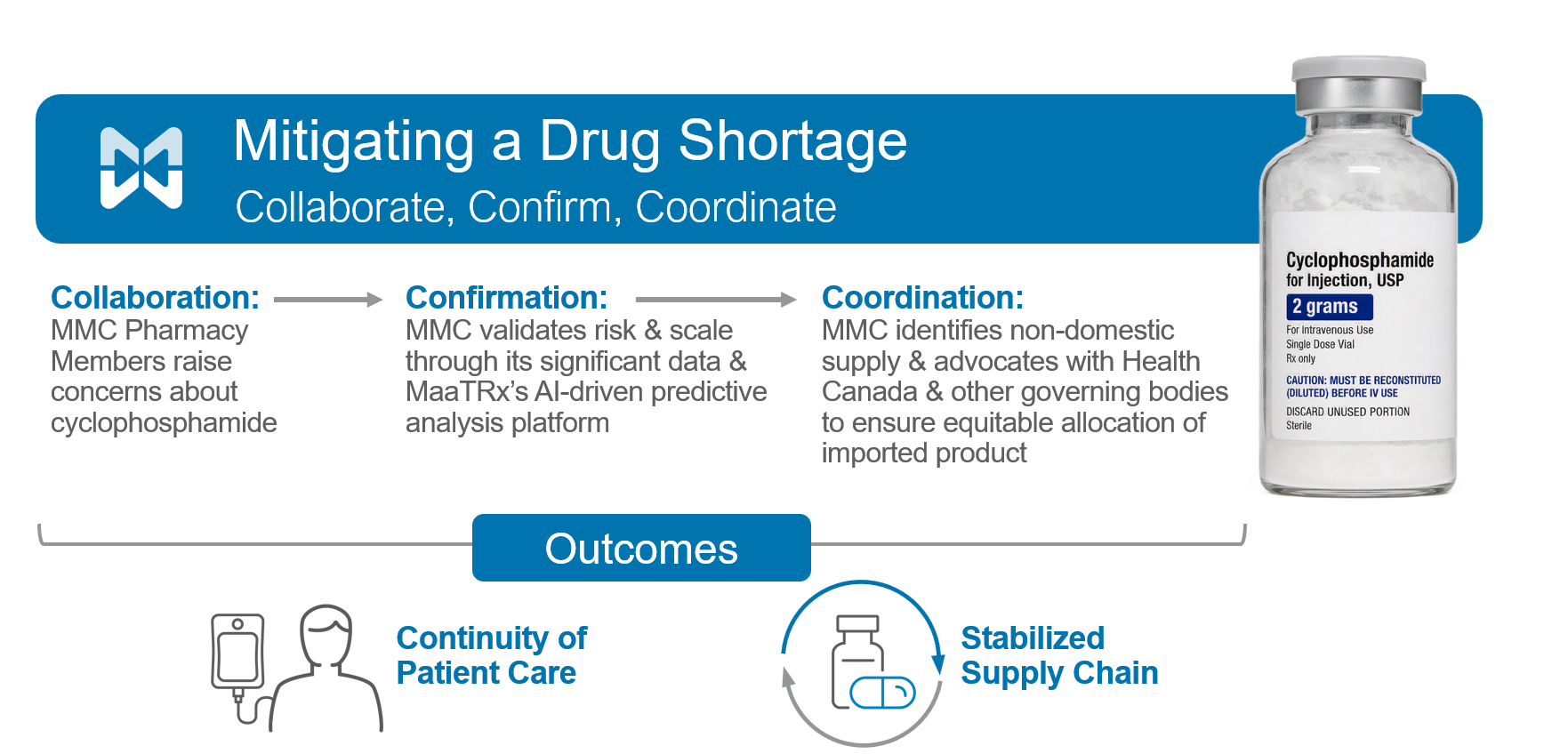
Mohawk Medbuy (MMC), a not-for-profit, shared services organization specializing in the health care supply chain, learned of a key manufacturer’s shortage of cyclophosphamide in late 2025. As one of the largest providers of contracting and procurement solutions for medical/surgical supplies and pharmaceutical products in Canada, MMC works in close collaboration with its Member hospitals and clinicians. When Members shared concerns about the availability of cyclophosphamide, MMC leveraged its substantial procurement data to validate and take action to address the situation.
As medical supply shortages have become more complex over recent times, MMC has elevated the support it provides Member hospitals through MitigAID, the supply disruption management platform it developed and launched in 2019. Combining supplier information, MMC’s significant procurement data and clinical guidance on substitute products, MitigAID identified substitutes for 77% of the 1,006 drug supply disruptions reported in 2025/26. Supporting hospitals by investigating alternate products and their availability reduces the administrative burden on their pharmacy teams and helps mitigate the impact of supply disruptions on patient care.
“Our challenge is no longer simply responding to shortages after they occur,” says Ally Dhalla, MMC’s Senior Vice President, Pharmacy, Government and Clinical Services. “The priority is identifying risks earlier and developing coordinated responses before patient care is affected.”
Learn more in the video below.

Ally Dhalla, MMC’s SVP, Pharmacy, Government & Clinical Services explains how advanced analytics combined with MaaTRx helped MMC Members proactively navigate a shortage of a critical chemotherapy drug called cyclophosphamide.
In the case of cyclophosphamide, there’s currently no feasible substitute, making a shortage significantly disruptive to cancer treatment. MMC supplemented its own data insights from MitigAID by consulting MaaTRx, a drug shortage intelligence platform developed at the University of Toronto. Using AI-enabled predictive analytics, utilization trends and supply vulnerability indicators, MaaTRx verified the concerning shortage risk.
“MaaTRx was built around the idea that drug shortage preparedness needs to move beyond reactive methods only and toward proactive, data-driven planning and response,” said Dr. Mina Tadrous, Co-Founder and Scientific Lead at MaaTRx Inc. “With cyclophosphamide, our predictive analytics identified a rising risk profile before the shortage was widely visible. For a medicine as clinically important as cyclophosphamide, that early visibility and guided response really helped people dealing with it on the front lines. It gives leading organizations like MMC and their members time to plan, act and more effectively navigate the challenges of these backorders.”
From Prediction to Action
The significance of the cyclophosphamide shortage risk prompted MMC to proactively reach out to international suppliers to locate additional sources of the drug for the Canadian market. That included Sandoz Inc., which sells the drug in the US market, but not in Canada. Based on that outreach by MMC, Sandoz was one of the first to fulfill exceptional importation to help offset a pending shortage. MMC also engaged with Health Canada and other governing bodies to advocate for equitable distribution of additional supplies of the drug to health care providers across the country.
“In response to the cyclophosphamide shortage, Sandoz worked closely with health care institutions, regulatory authorities, MMC and other supply chain partners to secure access through special importation pathways into Canada,” explains Keveen Youndje, Sales Development Manager at Sandoz Canada. “Although cyclophosphamide is not part of our Canadian portfolio, we leveraged our global network to help address this critical supply challenge. This collaborative effort helped maintain access to an essential therapy for vulnerable patients and supported hospitals in delivering uninterrupted care during a period of supply constraints.”
Strengthening the Shortage Management Toolkit
To further strengthen supply security, MMC also negotiated access with a secondary provider, giving Member hospitals the opportunity to place advance orders to secure access in the event of a longer-term disruption.
The cyclophosphamide experience highlights how modern supply disruption management is evolving from crisis response to risk prevention. By translating early warning signals into coordinated action, health system partners were able to work behind the scenes to mitigate the impact of a looming shortage before it became a widespread challenge for hospitals and patients.
For hospitals across Canada, the significance of this case extends beyond a single medication. It demonstrates how frontline clinical intelligence, reliable health care procurement data, predictive analytics and coordinated supply chain action can work together to provide earlier visibility into emerging risks. This formula may be one of the health system's most valuable tools for protecting patient access to essential medicines.